
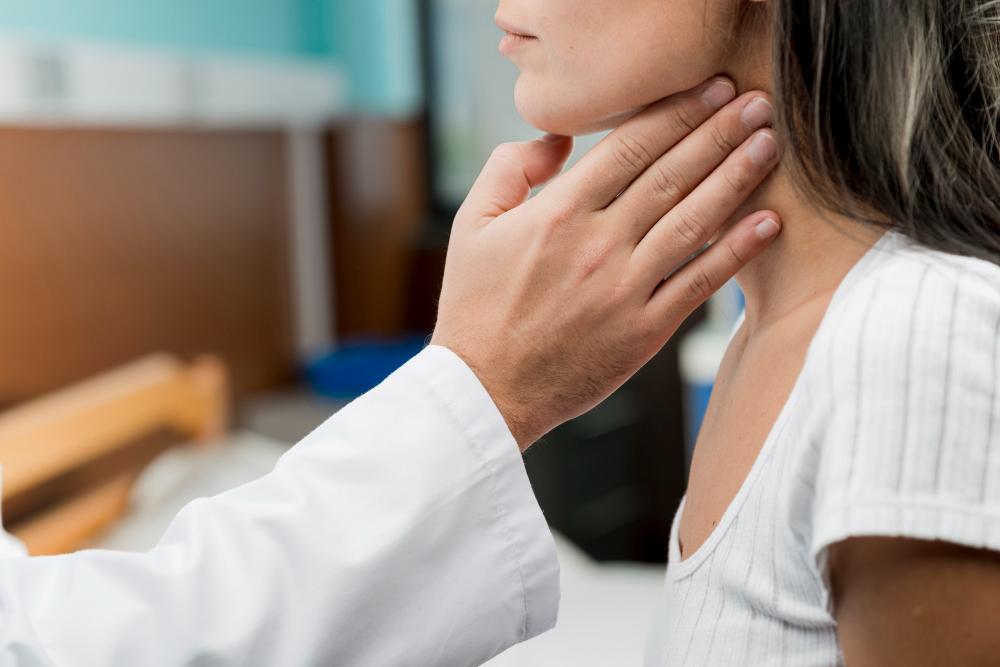
Thyroid Cancer in Boynton Beach, FL
Thyroid cancer is the most common endocrine malignancy in the United States — and one of the most treatable when detected early. The thyroid gland, located at the front of the neck just below the Adam’s apple, produces hormones that regulate metabolism, heart rate, and body temperature. When thyroid cancer develops, it most often presents as a thyroid nodule — a small lump within the gland — that may go unnoticed for months or years. At The Center for Sinus, Allergy, & Sleep Wellness, Dr. David C. Brodner provides thorough head and neck examination and diagnostic coordination for patients in Boynton Beach, FL with thyroid nodules or symptoms concerning for thyroid cancer. Call (561) 735-8750 to schedule your evaluation today.
Understanding Thyroid Cancer
Thyroid cancer develops from the cells of the thyroid gland and is classified into several distinct types based on the cell of origin and tumor behavior:
- Papillary thyroid cancer — The most common type, accounting for approximately 80% of cases. It grows slowly and has an excellent prognosis when caught early, even when it has spread to cervical lymph nodes.
- Follicular thyroid cancer — The second most common type, tending to spread through the bloodstream to distant organs (lungs, bones) rather than lymph nodes. Prognosis is generally good when diagnosed before distant metastasis.
- Medullary thyroid cancer — Arises from parafollicular C cells and may occur sporadically or as part of inherited syndromes (MEN2). It is associated with elevated calcitonin levels and requires different management than differentiated thyroid cancers.
- Anaplastic thyroid cancer — A rare but highly aggressive form with a poor prognosis. It typically presents as a rapidly growing neck mass in older patients.
Symptoms and Warning Signs
Many thyroid cancers — particularly papillary and follicular types — are slow-growing and may produce no symptoms in early stages, often discovered incidentally on imaging performed for another reason. However, patients and physicians should be alert to:
- A palpable lump or nodule in the front of the neck
- Unexplained hoarseness or voice changes
- Difficulty swallowing or breathing
- Persistent neck pain
- Swollen lymph nodes in the neck
- A rapidly enlarging neck mass
If you notice any of these symptoms in Boynton Beach, FL, prompt evaluation at The Center for Sinus, Allergy, & Sleep Wellness is important. Call (561) 735-8750 today.
Diagnosis of Thyroid Cancer
When a thyroid nodule or concerning neck mass is identified, Dr. Brodner coordinates the appropriate diagnostic workup, which typically includes:
- Ultrasound imaging — The primary imaging tool for evaluating thyroid nodules, providing detailed information about nodule size, composition, and characteristics that help stratify malignancy risk
- Fine needle aspiration (FNA) biopsy — A minimally invasive procedure in which a thin needle is used to sample cells from the thyroid nodule for cytological analysis — the definitive step in determining whether a nodule is benign or malignant
- Nuclear medicine scans — Used in selected cases to assess thyroid function and nodule activity
- CT or MRI imaging — To assess extent of disease and involvement of surrounding structures when malignancy is suspected
Treatment of Thyroid Cancer
Treatment depends on the type, size, and stage of thyroid cancer, as well as the patient’s age and overall health. Most thyroid cancers are treated with surgery — either removal of the affected lobe (hemithyroidectomy) or total removal of the thyroid gland (total thyroidectomy). Following surgical removal:
- Radioactive iodine (RAI) therapy — Used after thyroidectomy in selected patients to destroy any remaining thyroid tissue or distant metastases
- Thyroid hormone replacement — Required lifelong after total thyroidectomy to maintain normal metabolism and suppress TSH stimulation of any residual thyroid tissue
- Radiation therapy or chemotherapy — Reserved for advanced or aggressive thyroid cancers not amenable to surgical control
At The Center for Sinus, Allergy, & Sleep Wellness, Dr. Brodner provides comprehensive head and neck evaluation and biopsy coordination for patients with thyroid nodules, and refers to appropriate head and neck surgery, endocrinology, and oncology specialists for patients requiring multidisciplinary thyroid cancer management.
Frequently Asked Questions About Thyroid Cancer
Are all thyroid nodules cancerous?
No. The vast majority of thyroid nodules — approximately 90 to 95% — are benign. However, all palpable or incidentally discovered nodules meeting certain size or characteristic criteria should be evaluated with ultrasound and, when indicated, fine needle aspiration biopsy to establish their benign or malignant nature. The decision to biopsy is guided by nodule size, ultrasound characteristics, and risk factors.
What is the prognosis for thyroid cancer?
Thyroid cancer — particularly the most common type, papillary thyroid cancer — carries an excellent prognosis when detected at an early stage. The overall ten-year survival rate for papillary thyroid cancer is greater than 95% in most series. Even papillary thyroid cancer that has spread to cervical lymph nodes remains highly treatable. Follicular thyroid cancer has a somewhat less favorable prognosis when distant metastasis is present. Anaplastic thyroid cancer, while rare, carries a significantly worse prognosis.
Do I need to take medication after thyroid surgery?
If the entire thyroid gland is removed (total thyroidectomy), lifelong thyroid hormone replacement therapy with levothyroxine is required to maintain normal metabolism, energy, and overall health — as well as to suppress TSH stimulation of any potential residual thyroid tissue. If only half the thyroid is removed (hemithyroidectomy), the remaining lobe may produce sufficient hormone, though some patients ultimately require supplementation. Your endocrinologist will monitor thyroid hormone levels and adjust dosing as needed.
What are the risk factors for thyroid cancer?
Known risk factors include: female sex (thyroid cancer is approximately three times more common in women), age between 25 and 65, prior radiation exposure to the head and neck (especially in childhood), a family history of thyroid cancer or related thyroid conditions, and inherited genetic syndromes such as MEN2 (associated with medullary thyroid cancer) and familial adenomatous polyposis. Most thyroid cancers, however, occur in patients without any clear identifiable risk factor.
Can thyroid cancer cause hoarseness?
Yes. When thyroid cancer grows large enough to invade or compress the recurrent laryngeal nerve — which controls the vocal cords — it can cause hoarseness or vocal cord paralysis. Unexplained hoarseness, particularly in a patient with a known or newly discovered thyroid nodule, should always prompt urgent ENT evaluation. Dr. Brodner performs laryngoscopy to assess vocal cord function and refers for appropriate imaging and surgical evaluation when recurrent laryngeal nerve involvement is suspected. Call (561) 735-8750 for prompt evaluation at The Center for Sinus, Allergy, & Sleep Wellness.
What is the connection between thyroid cancer and the ENT?
Thyroid cancer falls within the scope of head and neck surgery — a specialty that encompasses otolaryngology. ENT physicians trained in head and neck surgery evaluate thyroid nodules, coordinate biopsy, and often perform thyroid surgery. At The Center for Sinus, Allergy, & Sleep Wellness, Dr. Brodner performs comprehensive head and neck evaluation for patients with thyroid concerns and refers to specialized head and neck surgery, endocrinology, and oncology teams for patients requiring surgical management or ongoing cancer care.
How is thyroid cancer different from hypothyroidism or hyperthyroidism?
Hypothyroidism (underactive thyroid) and hyperthyroidism (overactive thyroid) are functional disorders of thyroid hormone production — they are not cancers. Thyroid cancer is a structural malignancy arising from thyroid cells. A patient can have a thyroid nodule that turns out to be cancer while having normal thyroid function tests, which is why thyroid nodule evaluation requires ultrasound and often biopsy — not just blood tests. Conversely, a patient with hypothyroidism does not necessarily have cancer.
Thyroid Nodule and Cancer Evaluation in Boynton Beach, FL
A thyroid nodule discovered on examination or imaging should never be ignored. Early evaluation is essential — and at The Center for Sinus, Allergy, & Sleep Wellness, Dr. Brodner provides the expert head and neck assessment needed to determine next steps quickly. Call (561) 735-8750 or request an appointment online. Same-day and next-day availability for patients throughout Boynton Beach, FL and Palm Beach County.